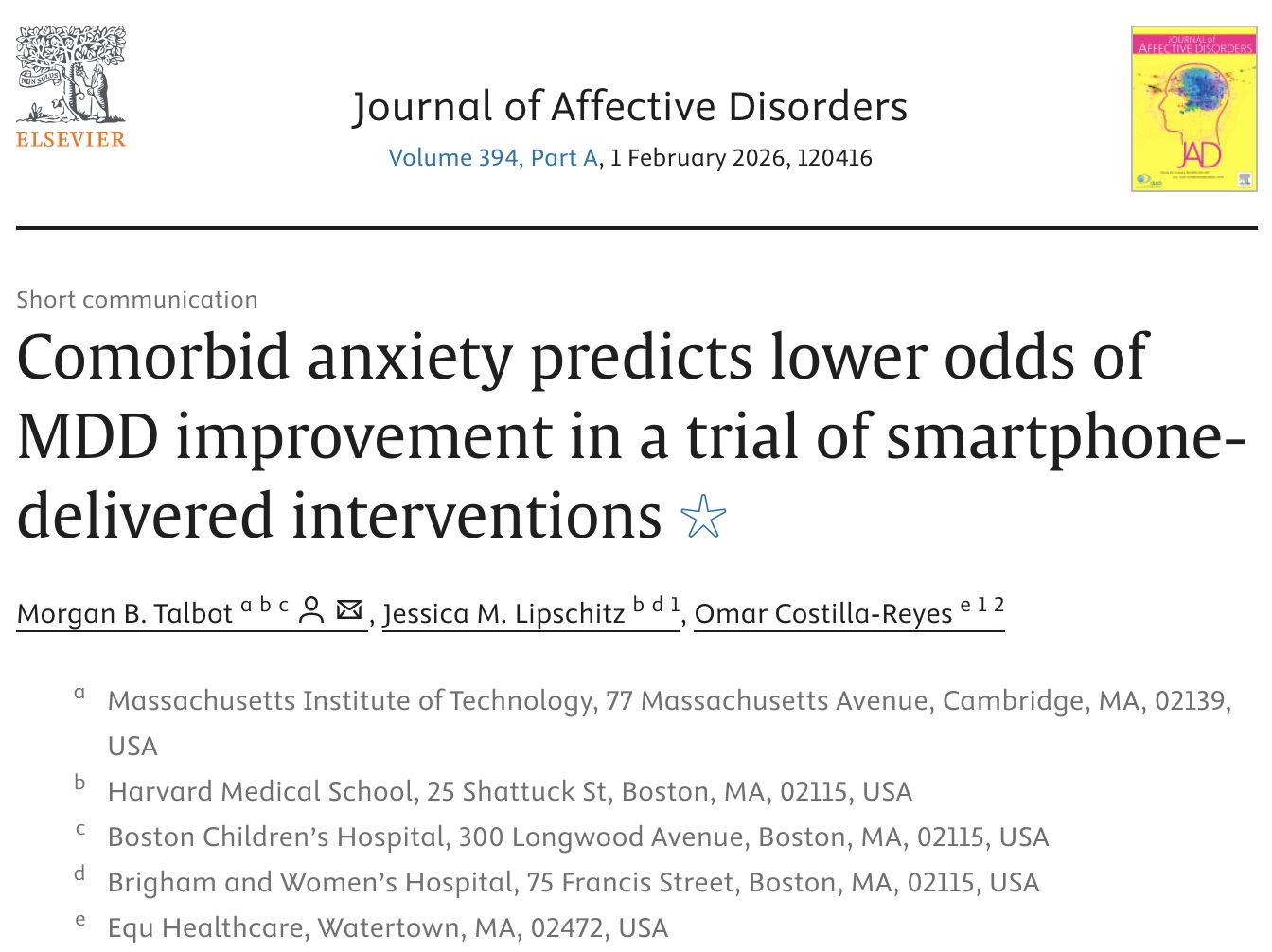
Equ Healthcare is pleased to announce new peer-reviewed research in the Journal of Affective Disorders, conducted with collaborators from the Massachusetts Institute of Technology and Harvard Medical School.
Study Overview
Smartphone-delivered treatments can expand access for people with major depressive disorder, but treatment response varies widely. The study analyzed a randomized controlled effectiveness trial with 638 participants across three app-based interventions: Project EVO, iPST, and Health Tips.
The research team used interpretable machine learning models, including logistic regression, support vector machines, decision trees, random forests, and k-nearest neighbors, to identify baseline clinical and behavioral features linked to depressive symptom improvement after four weeks.
Key Findings
Baseline anxiety emerged as the strongest and most consistent predictor of treatment outcome across models and intervention types.
A decision tree identified a clear clinical threshold: participants with a baseline GAD-7 score of 11 or higher, indicating moderate anxiety, had significantly lower odds of depressive symptom improvement.
The association held across each intervention group, suggesting a broadly relevant prognostic factor rather than an app-specific effect.
Why the Finding Matters
Digital mental health interventions are not one-size-fits-all. Comorbid anxiety may indicate the need for enhanced support, blended care, or a tailored therapeutic pathway.
The study also demonstrates the value of explainable artificial intelligence. Interpretable models can provide clinicians and product teams with actionable rules that support treatment selection, stepped-care strategies, and transparent decision-making.
Equ Healthcare's Role
This publication reflects Equ Healthcare's commitment to transparent, clinically meaningful AI for mental health. Our work connects wearable, behavioral, and clinical signals into clear insights that support personalized and preventive care.