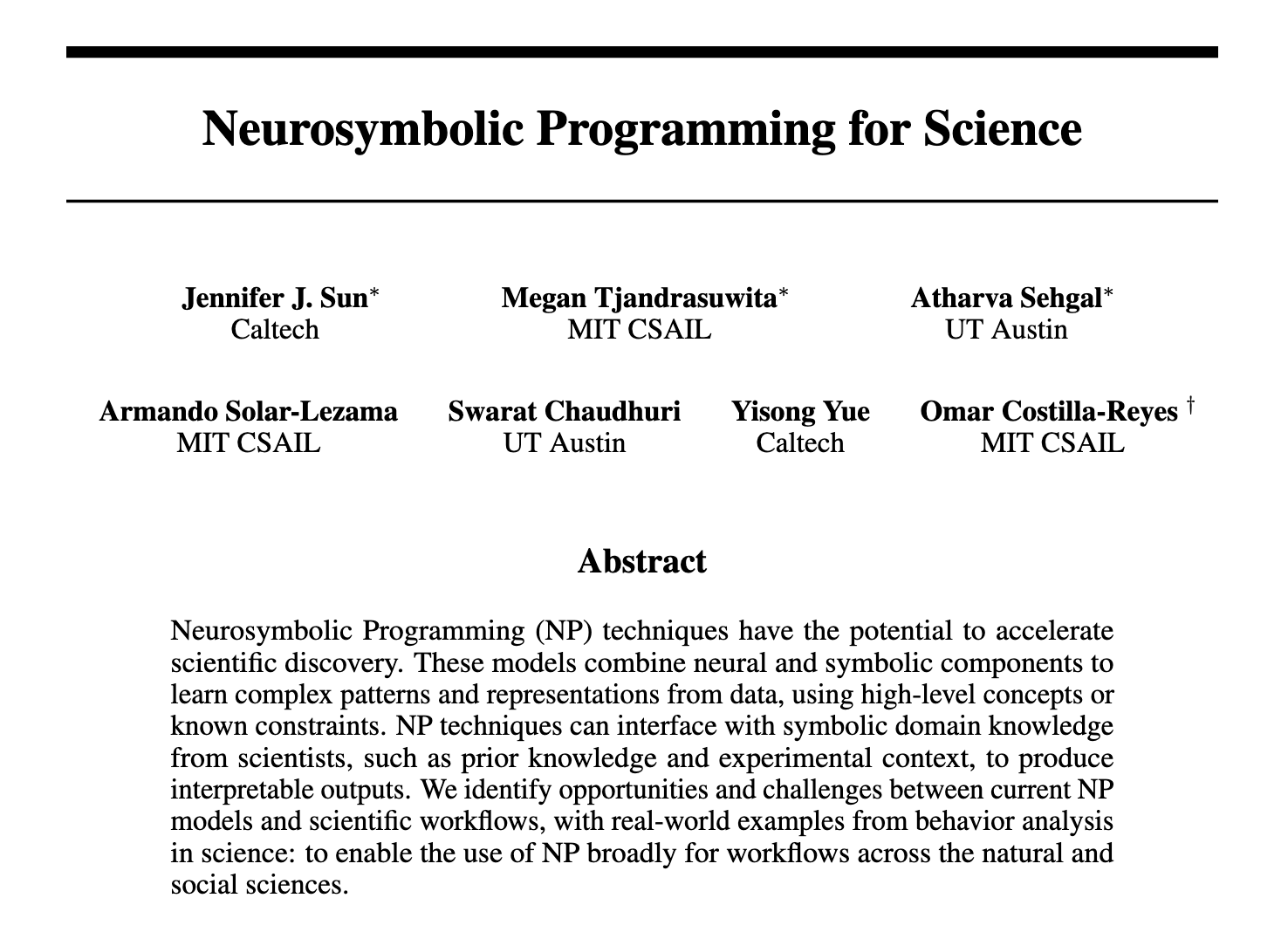
Modern scientific research needs computational methods that can process large experimental datasets while preserving interpretability and scientific rigor. Neurosymbolic programming addresses that need by combining the pattern-recognition power of neural networks with the explicit reasoning of symbolic systems.
The Interpretability Challenge
Deep neural networks have transformed protein structure prediction, molecular design, image analysis, and many other domains. Yet opaque decision paths make scientific discovery harder when researchers need hypotheses, mechanisms, uncertainty estimates, and reproducible explanations.
The challenge is not merely technical. In science and healthcare, interpretability is part of responsible discovery.
The Neurosymbolic Approach
Neurosymbolic programming combines neural perception with symbolic reasoning. Neural models learn from raw data such as spectra, images, time series, and sensor streams. Symbolic components represent scientific rules, causal relationships, conservation laws, pathway structure, and clinical guidelines.
The resulting systems can learn from data while respecting explicit constraints and producing reasoning paths that experts can inspect.
Three Core Ideas
Perception: neural models read complex data, while symbolic priors help enforce scientific constraints and improve sample efficiency.
Abstraction: systems learn reusable concepts such as molecular functional groups, cellular phenotypes, physical regimes, or behavioral patterns.
Reasoning: symbolic logic, probabilistic programming, and differentiable theorem proving make the decision path inspectable, testable, and refinable.
Scientific Applications
Drug discovery and retrosynthetic planning: neurosymbolic architectures can connect structure-activity learning with chemical reaction rules, synthetic feasibility constraints, and interpretable design rationales.
Quantum chemistry and materials design: physics-informed neural models can predict molecular energies and material properties while respecting symmetry, conservation, and physical consistency.
Systems biology and gene regulatory networks: symbolic structure can help transform gene expression analysis from correlation mining into mechanistic understanding.
Climate modeling and atmospheric science: hybrid models can combine data-driven learning of subgrid processes with thermodynamic laws, radiative transfer equations, and uncertainty quantification.
Implications for Equ Healthcare
For Equ Healthcare, neurosymbolic programming is a foundation for explainable health intelligence. Healthcare needs systems that connect wearable, behavioral, clinical, and contextual signals while explaining the pattern behind each recommendation.
Core applications include personalized therapeutic decision support, early disease prediction with mechanistic insight, multi-modal clinical data fusion, adaptive learning from medical evidence, and counterfactual clinical reasoning.
This paradigm shift is practical and ethical. In high-stakes health decisions, interpretability is mandatory. AI should make reasoning visible, rigorous, and scalable.